
There’s a corner of the city - not too far from my home but miles from DC’s monumental core - that has the comfortable feel of community. There’s a red-brick elementary school with a sprawling park alongside, and diagonally across from it a corner market frequented by young and old alike. When I go over there, to vote at the school, drop off used toys for a local charity, or sit outside the market on a nice day with a cup of coffee, the area gives off the timeless aura of a long-established neighborhood.
Which is true, up to a point. Or rather, from a certain point. The store now known as Broad Branch Market first opened in 1919, and was sold in 1926 to another family that ran it for 50 more years. Then, after a hiatus of 30-plus years, in 2008 it reopened and has been a fixture ever since.
The story of Lafayette Elementary School, across the way, is more complex. You’ll recall from an earlier post that Congress merged the then-City of Washington with surrounding Washington County in 1871, and over the following decades, the trolley line out Connecticut Avenue began bringing more and more people to live in areas that were gradually transitioning from their previously rural character. In the late 1800s, an enterprising Nevada politician and developer, Francis Newlands, conceived the Chevy Chase Land Company (CCLC), which began buying up land to develop the areas still known to this day as Chevy Chase DC and Chevy Chase, Maryland. Newlands and his partner, William Stewart, were wildly successful in attracting purchasers, and by the mid-1920s it became clear that a large tract of land was needed to accommodate this growing population moving north out Connecticut Avenue.
There was just one problem: the property identified for the school in the mid-1920s was already in private hands. An extended family, descended from Captain George Pointer, a supervisory engineer for the company founded by George Washington to start work on the C&O Canal, owned the property. In the mid-19th century, Pointer’s granddaughter, Mary Ann Harris, and her husband had bought several acres of land, which were subsequently subdivided for use by their daughter Mary Moten and other members of their extended family. This plot of land was the hub of the Dry Meadows Community, a thriving and self-sufficient rural enclave whose farmers sold their excess produce in then-and-now tony Georgetown, further south along the Potomac.
Despite the family’s longtime prominence in the community, they were no match for the Chevy Chase Land Company and its allies in the National Capital Park and Planning Commission. Remember, this was a time midway between the 1871 establishment of a unified federal district, under full federal governance, and the 1973 restoration of limited DC home rule. During this period, national politicians were even more thoroughly enmeshed in what happened within the District’s boundaries than they are today. This was also an era when short-lived postwar Reconstruction was giving way to Jim Crow. And the Pointer descendants were Black – a well-off Black family that had remained free from the time George Pointer purchased his freedom in 1793 through the end of the civil war - while the people moving north up Connecticut Avenue were White. By design. And this is where “eminent domain” came into play, because there was no room for Blacks, well-off or not, in the vision of Newlands and his successors in the CCLC. The Harris-Moten family had to go. The land was purchased, reportedly and unsurprisingly for less than it was worth, and the family was dispersed from this tight-knit area they had cultivated, literally and figuratively, for close to a century.
The Lafayette school opened in 1931, and has been a hub of education and activity ever since.
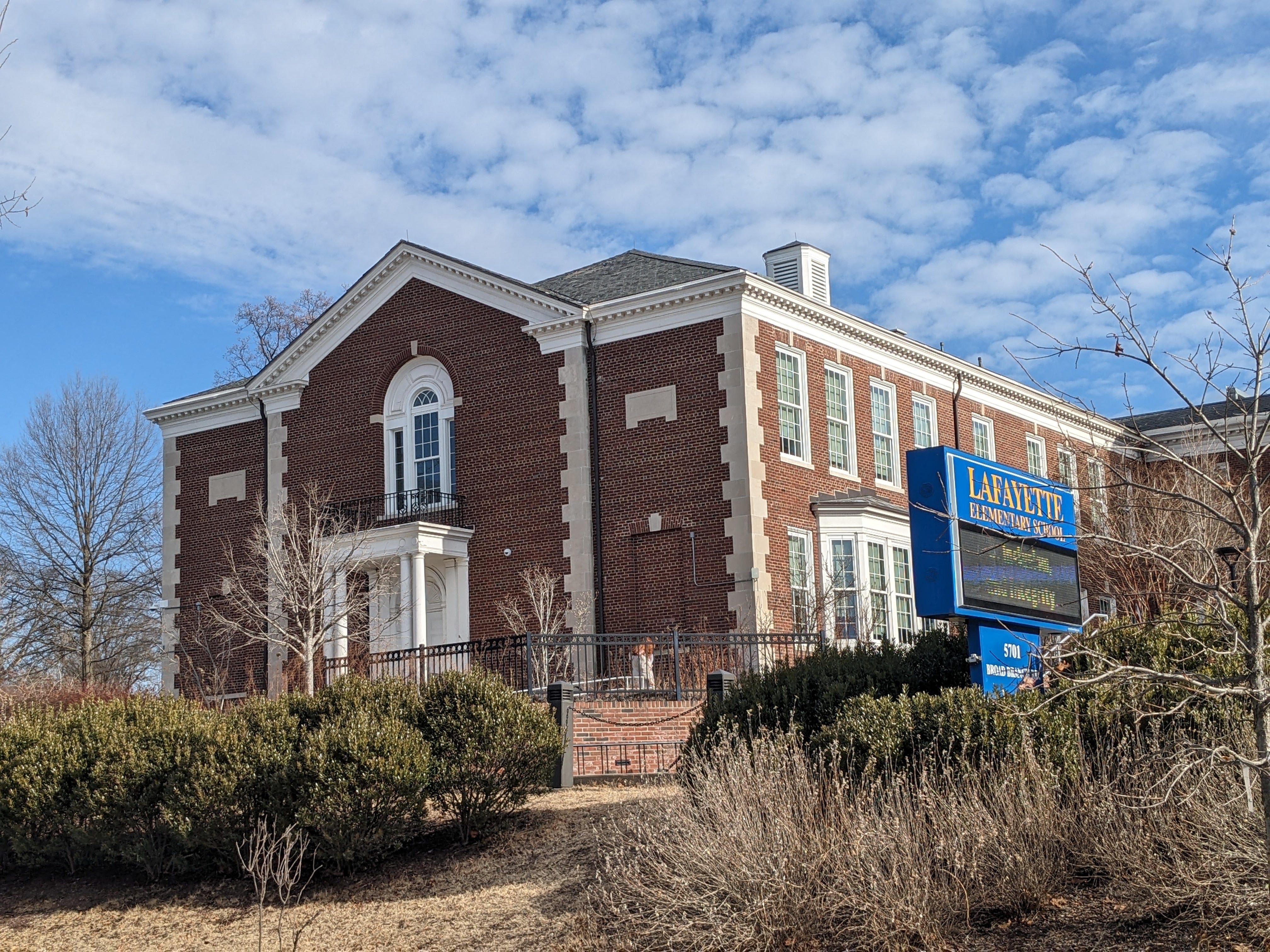
This is how the groundwork was laid for a neighborhood that now seems timeless – and timelessly White. No, the school and the area are no longer formally segregated, although for many decades after the 1930s there were covenants in Chevy Chase real estate deeds to keep them so, but without a doubt the neighborhood remains overwhelmingly White. It has only been in recent years that local historians, in collaboration with Pointer family descendants and the Historic Chevy Chase DC organization, have brought to light the deeper history. This research led to the renaming of the park alongside the school in 2021, which is now known as “Lafayette-Pointer Park.” There is still so much more to learn, and so much more to say about other DC neighborhoods that underwent similar transformation. All of it is just another reminder of the key role that African Americans have always played in the history of DC, and the ongoing role of racial discrimination in DC’s social and political evolution – then and now.
Which brings us back to Broad Branch Market, where a photograph of Percy Edwards, or “Curly,” a once-beloved deliveryman, hangs above the cash register. I don’t know what became of him when he was no longer working at the Bondareffs’ store, although some still in the neighborhood fondly remember him. Those neighbors are White. He was Black. I can’t help wondering what stories about this corner of the city Mr. Edwards would tell.
https://www.broadbranchmarket.com/hundred-year-history
https://www.chevychasehistory.org/index.php/chevychase/about-chevy-chase-0
https://betweenfreedomandequality.org/the-remarkable-lives-of-george-pointer-and-his-family/
https://www.historicchevychasedc.org/oral-histories/helen-higgins/
So interesting, Carol! My father (born in DC in 1912) used to tell of his parents looking for property in the country in the 1920s, and choosing between some land near what's now Chevy Chase Circle, and some other property out East Capitol St. in what's now Capitol Heights. They chose the latter.
Great story, Carol! It shows how important the history and stories of our communities are.