DC Chinatown: A Storied Immigrant Community
An essential part of DC’s cultural and economic history

First, an update on last week’s post about prospects for the DC economy:
- On February 12, the Senate joined the House in overturning the vote of our democratically-elected DC council which would have allowed us to raise and spend our own local taxes as we wish. The Senate vote may have taken place outside the allowable 30-day review period, but my betting is that the Congressional action will stand and the president will sign off on this override of our local democracy.
- On February 11, the chair of the Kennedy Center board sent an email to the Center’s staff to prepare them for significant layoffs during the president’s announced two-year closure for renovation.
- Three days after the Washington Post announced the layoff of large numbers of staff, Will Lewis, the Post publisher appointed in 2023 by Jeff Bezos, stepped down from his position.
So there we are. Yes, I know my readers are probably more focused on national developments. But here – in the capital of our country – local democracy and economic livelihoods are on the ropes. That’s of concern, on this Presidents Day in the 250th year of our democratic experiment.
But we also have lighter matters on our minds! As I write this, DC is looking forward to our annual parade marking the Lunar New Year – the Year of the Horse - which this year will take place on February 22. When you think of Chinatown, you probably think of New York or San Francisco, but if you’ve been to DC, you will have seen that the station nearest the Capital One Arena, where the Capitals and the Wizards play, is named “Gallery Place/Chinatown.” And there is a reason for that. Since the mid-19th century there has been a well-established enclave of Chinese and other Asian immigrants in DC. In the early years, residents of DC’s “Chinatown,” located along a portion of Pennsylvania Avenue a little west of the Capitol, suffered from the indignities and discrimination that followed the 1882 Chinese Exclusion Act, but they persevered. In the early 1930s, the community of several hundred was forced to move to make way for new federal buildings, and since that time, DC’s Chinatown has been located roughly where it remains today, centered in the area along H Street between 5th and 8th Streets, NW. In the 1950s, the DC chapter of the Chinese Consolidated Benevolent Association (CCBA) was formed to provide support to the community, and it remains the main sponsor of the annual parade to this day. By the 1950s, the Chinatown community in DC was approaching 1000 souls.
I moved to DC in the late 1970s, and by the early 1980s I was settling into domesticity here in my adoptive home. At that time, Chinatown was still easily identifiable, with several well-known restaurants that catered to an authentically Asian-American clientele as well as others that appealed more to mainstream American expectations of “Chinese food.” (One little-known fact is that the Surratt boarding house, where conspirators John Wilkes Booth and others planned the assassination of President Lincoln, is the site of one longstanding Chinese restaurant at 6th and H.) When we were setting up our household in the early 1980s, there also were several small groceries that carried the essentials for Asian cuisine, and I well remember when we bought our wok at one of them. For a long while, this neighborhood was also the only place I could go to buy lychees, still a favorite of mine.
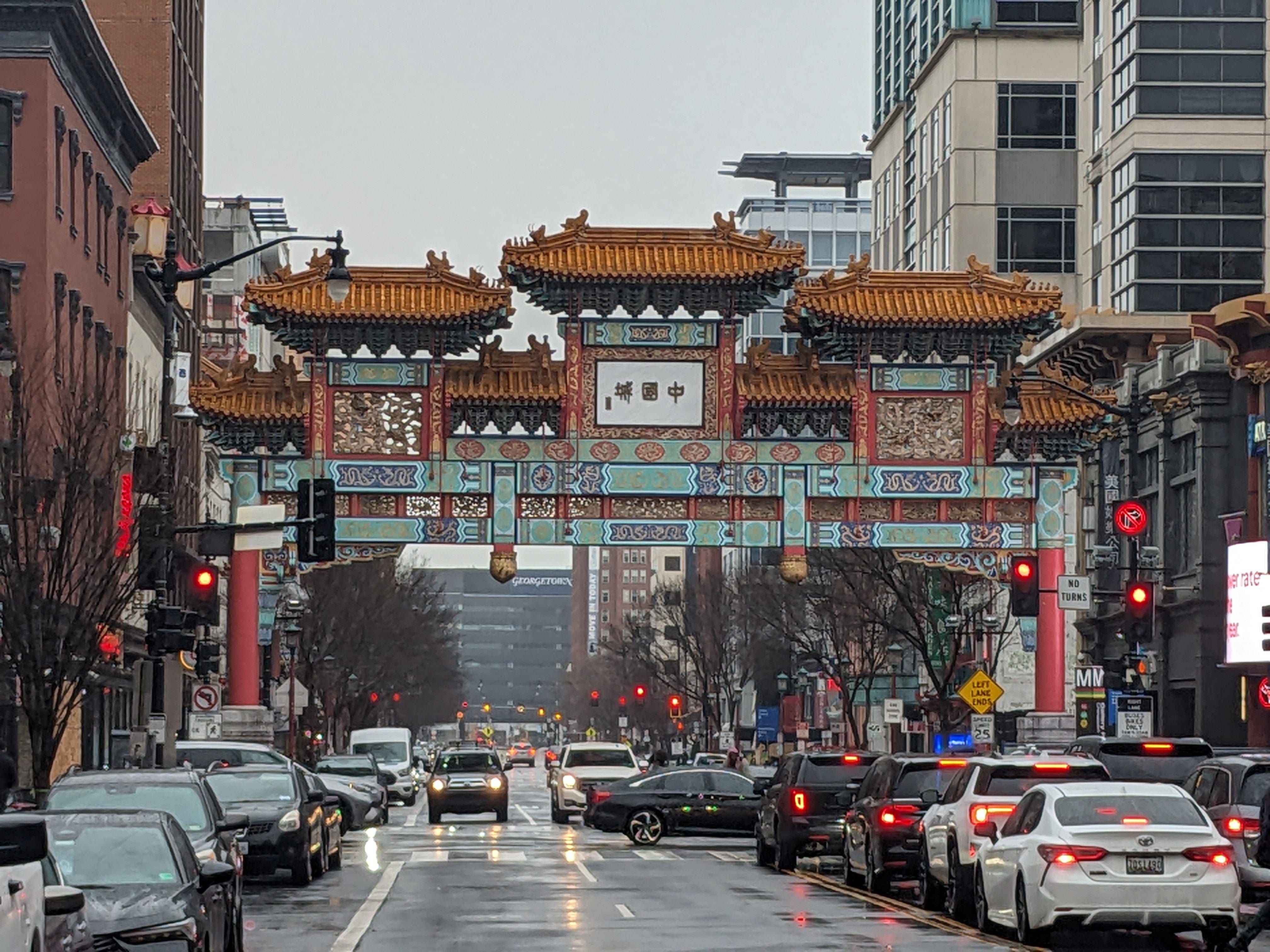
Although I didn’t realize it when I first came to DC, by the 1970s Chinatown, which had peaked at a population of around 3000, was already coming under serious pressure, with many Chinese residents forced to move out of the area into the suburbs and the actual footprint of Chinatown consistently shrinking. This was in part due to the construction of the Metro station, but even more so due to construction of the first (since imploded) downtown convention center, which for two decades starting in 1982 filled the two blocks square known in our present day as “City Center.” Large-scale activism by the residents headed off worse outcomes, but without a doubt those developments hastened the decline of the neighborhood’s recognizable Asian character. To head off the hemorrhaging, in the late 1970s, architect Alfred Liu, a Taiwanese immigrant, cooperated with the administration of Mayor Marion Barry to identify a site for a public-housing complex, which opened in 1982 as the 153-unit Wah Luck House, still a neighborhood fixture operating under a ground lease to the CCBA. A few years later, Mayor Barry concluded a Sister-City arrangement with Beijing, and in the face of some community opposition, the Friendship Archway was co-funded by the PRC and the city, and placed at the corner of 7th and H streets in 1986. (Plans for one or more competing archways eventually died down.) Interestingly, the arch, which still stands today as a symbol of the community’s longtime Asian character, was also designed by Taiwan-born architect Liu.
These efforts were not enough to halt the outward population movement though, especially as property values continued climbing precipitously. This outmigration was accelerated with the 1997 opening of the Capital One Arena (then the MCI Center) atop the Metro station. The arena has made the neighborhood into a sports and dining mecca, but at the expense of the neighborhood’s unique character: by the 2010s, Chinatown’s resident population was only around 300 people, a large portion of them living in the Wah Luck House.
DC’s Chinatown has followed a story similar to that of many immigrant communities in the US – suffering, discrimination, and tenacity, usually leading to integration and acceptance into mainstream American life. We come to value these established ethnic neighborhoods that give our cities their uniqueness, these recent arrivals who bring new vibrancy to our broader population. The process isn’t a smooth or quick one though, and as we see all around us now, the acceptance goes in cycles.
But DC’s Lunar New Year parade will go on this coming weekend nevertheless, in our very own Chinatown, one mile due east of the White House.
Grenell announcement to Kennedy Center staff https://wapo.st/4r9Zu2J
Will Lewis steps down https://www.yout-ube.com/watch?v=D2_FaKcBEUo
https://dcparade.com/
https://en.wikipedia.org/wiki/Chinatown_(Washington,_D.C.)
https://www.facebook.com/ccbaDC/
https://en.wikipedia.org/wiki/Capital_One_Arena
https://apiahip.org/everyday/day-267-wah-luck-house-washington-dc
https://ggwash.org/view/69245/the-story-and-meaning-behind-chinatowns-friendship-archway-in-dc
https://www.yout-ube.com/watch?v=mVRWSmUO0dk Chinatown through the eyes of residents
https://historicsites.dcpreservation.org/tours/show/70 Asian-American sites in DC